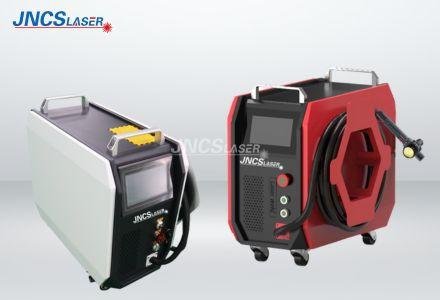
The CW (Continuous Wave) 1500W fiber laser welding machine and the QCW (Quasi-Continuous Wave) 300W fiber laser welding machine, both equipped with a big crane, differ primarily in their laser output modes, power levels, and application suitability. Here’s a breakdown of the differences:
1. Laser Output Mode:
- CW (Continuous Wave) 1500W Fiber Laser Welding Machine:
- Operates in continuous mode, meaning it emits a constant, uninterrupted laser beam.
- Best suited for high-speed, deep penetrationwelding applications where a continuous, strong heat input is necessary.
- It is ideal for welding thick materials and for tasks that require faster weld speeds and deeper weld penetration.
- QCW (Quasi-Continuous Wave) 300W Fiber Laser Welding Machine:
- Operates in pulsed modebut can also simulate continuous wave operation when needed.
- The pulsed nature of the laser provides high peak powerin short bursts, which is perfect for welding delicate, thin materials that require controlled heat input.
- Suitable for applications requiring precisione fine welding, especially for intricate or detailed work, and for situations where thermal distortion must be minimized.
2. Power Output:
- CW 1500W:
- Provides 1500W continuous power, making it capable of welding thicker materialslike heavy-duty metals (e.g., steel, aluminum, titanium) in industrial applications.
- The high power allows for fast welding speedse deep penetration welds, making it suitable for more robust industrial applications like shipbuilding, aerospace, automotive, and large metal structures.
- QCW 300W:
- The 300W pulsedoutput provides high peak power during each pulse but at a lower average power compared to the 1500W CW machine.
- It is designed for precisee high-quality welding on thinner or more delicate materials, such as those used in mold repair, electronics, or precision fabrication.
- Lower power makes it more suitable for surface-level repairsand fine, detailed work rather than welding very thick metals.
3. Heat Affected Zone (HAZ):
- CW 1500W:
- Due to its high continuous power, the heat-affected zone is larger. This can lead to more heat being distributed over a wider area, which could result in distortion or warping on thin or heat-sensitive materials.
- Best used for materials that can tolerate more heat, such as thicker metals.
- QCW 300W:
- The pulsed nature of the QCW machine generates a smaller heat-affected zone, making it ideal for delicate weldingtasks where precision is key and thermal distortion needs to be minimized.
- Suitable for thin metalsand applications that require minimal material deformation.
4. Applications:
- CW 1500W Fiber Laser Welding Machine:
- Ideal for high-speed weldingof thick materials where deep weld penetration is required.
- Common in heavy industries like automotive manufacturing, shipbuilding, aerospace, and industrial metal fabrication.
- Suitable for structural welds, frames, and other large components where speed and strength are priorities.
- QCW 300W Fiber Laser Welding Machine:
- Designed for precision weldingtasks, such as mold repairs, small component fabrication, electronics, and medical devices.
- Best suited for applications where the quality of the weldis more important than the depth or speed, such as jewelry, tooling, and fine metal work.
- Ideal for repairing small partsand intricate components that require detailed and accurate welds.
5. Welding Speed:
- CW 1500W:
- Can weld at much faster speeds due to the high continuous power output, making it ideal for high-throughputproduction environments.
- QCW 300W:
- Slower welding speeds compared to CW machines because it operates in pulsed mode, focusing on precision over speed.
6. Energy Consumption:
- CW 1500W:
- Consumes more energy due to the continuous power output.
- Typically suited for industries where throughput and speed justify the higher energy consumption.
- QCW 300W:
- Consumes less energy because it operates in pulsed modewith lower average power, making it more energy-efficient for precision applications.
Summary of Differences:
Feature | CW 1500W Fiber Laser Welding Machine | QCW 300W Fiber Laser Welding Machine |
Modo Laser | Continuous Wave (constant beam) | Quasi-Continuous Wave (pulsed & continuous) |
Power Output | 1500 W | 300W (high peak power pulses) |
Best For | Thick, heavy-duty materials; deep welds | Precision welding on thin/delicate materials |
Welding Speed | Fast, high throughput | Slower, focused on accuracy |
Heat Affected Zone (HAZ) | Larger HAZ, more heat spread | Small HAZ, minimal heat spread |
Aplicativo | Heavy industry (automotive, aerospace, etc.) | Precision industries (mold repair, electronics) |
Energy Consumption | Higher due to continuous operation | Lower due to pulsed operation |
Welding Depth and Strength | Deep penetration | Surface welding and fine detail work |
Conclusion:
The CW 1500W fiber laser welding machine with a big crane is suited for high-speed, deep penetration welding of thick materials, ideal for industrial applications where throughput and strength are priorities. In contrast, the QCW 300W fiber laser welding machine with a big crane is designed for precision welding of thinner materials, with a focus on minimizing heat distortion and achieving fine, detailed welds.
Bem-vindo a entrar em contato conosco para mais detalhes.
 CN
CN AR
AR ES
ES RU
RU